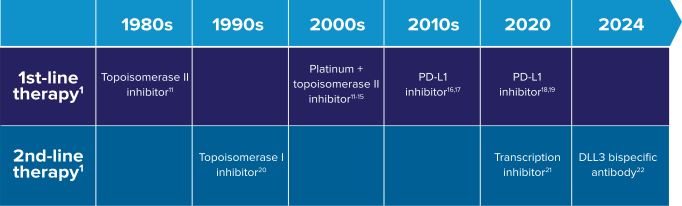
DLL3=delta-like ligand 3; PD-L1=programmed death-ligand 1.
Relapse and Survival in SCLC
Although SCLC is initially responsive to chemotherapy and radiation, the vast majority of patients will recur and have a short median duration of survival.1,2 This attribute of SCLC is the key challenge to developing new treatments, improving duration of response, and disease-free survival.2
STATISTICAL OVERVIEW2,3
PATIENTS WITH SCLC ARE
AT HIGH RISK OF RELAPSE
~75%
OF PATIENTS
with locally
advanced disease
>90%
OF PATIENTS
with metastatic disease
PROGRESS WITHIN
2 YEARS OF TREATMENT
MEDIAN SURVIVAL DURATION
<2YEARS
FOR PATIENTS
with early-stage disease
~1YEAR
FOR PATIENTS
with metastatic disease
2-4
MONTHS
when untreated
IN PATIENTS WITH
RELAPSED SCLC
- Many of these patients are candidates for additional systemic small cell lung cancer treatment1
- Responses to second-line therapy vary based on the time from last therapy to relapse, the response to initial treatment, and overall performance status1,4
SEVERAL FACTORS DRIVE THE DECISION TO STOP TREATMENT AFTER FIRST-LINE IN LS-SCLC AND ES-SCLC PATIENTS5
Experience After First-Line Treatment
ONLY ~40%
RECEIVE 2L TREATMENT6
2L=second-line.
- Systemic therapy after first-line treatment failure remains an important component of the treatment paradigm7
Vigilant monitoring and early conversations are important to determine if patients could benefit from subsequent treatment.2,8
CHOOSING A SECOND-LINE THERAPY
- When determining what the best second-line therapy for a patient may be, many HCPs evaluate if their disease is sensitive or resistant to first-line chemotherapy. They base this on the chemotherapy-free interval (CTFI), defined as the length of time from last platinum dose to time of relapse or disease progression4,7,9
- However, there is no consensus in the literature as to what length of time determines different treatment decisions
- For example, treatment recommendations in the NCCN Clinical Practice Guidelines in Oncology (NCCN Guidelines®) do not take into account CTFI, while the European Society for Medical Oncology (ESMO) clinical recommendations are dependent on a CTFI >90 days1,10
- Subsequent systemic therapy provides significant palliation in many patients, although the likelihood of response is highly dependent on the time from initial therapy to relapse1
- As such, recommendations for second-line treatment vary based on the time to relapse1
- Longer relapse-free days post-completion of chemotherapy are thought to help contribute to a higher probability of second platinum response1,9
- The optimal duration of subsequent systemic therapy has not been fully explored1
- The most common and accepted approach is to continue treatment until progression or development of unacceptable toxicity beyond best response (for chemotherapy), progression of disease, or development of unacceptable toxicities1
- Additional subsequent systemic therapy (eg, third-line) can be considered if patients are still performance status (PS) 0 to 21
Summary of Preferred Systemic Therapies in LS- and ES-SCLC1
FIRST-LINE TREATMENT
Limited Stage
Platinum-based therapy +
concurrent
radiation therapy
Extensive Stage
Platinum-based
therapy
+ immunotherapy
CONSOLIDATION/MAINTENANCE THERAPY
Limited Stage
Immunotherapy
Extensive Stage
Chemotherapy + immunotherapy
or immunotherapy alone
SUBSEQUENT THERAPY
Systemic therapy, original regimen, or clinical triala
aThe use of immune checkpoint inhibitors is discouraged if there is progression on maintenance atezolizumab or durvalumab at time of relapse.1
IF PROGRESSION CONTINUES TO OCCUR
- Since SCLC is an aggressive cancer, timing is important, along with having a plan for relapsed patients1,23
- Treatment options depend on what the patient has received prior to relapse, toxicity of treatment, and performance status1
- Individual patient characteristics also play a role in creating a personalized treatment regimen1,2
- The field of SCLC research has seen notable progress in understanding tumor biology and malignant progression and developing new strategies for treatment1,2,24
PATIENT CONSIDERATIONS IN DETERMINING SUBSEQUENT THERAPIES1,2
STATUS 0-2
TREATMENT OPTIONS
symptom management including localized RT is offered1
Relapse is common. To manage care, appropriate patients may need to move to second-line treatment. It is critical to consider the patient performance status and appropriate treatment options available, and to monitor for early signs of relapse.1,2,5,8
Explore a treatment option
Consider all of your treatment options
as you manage small cell lung cancer.1
NCCN=National Comprehensive Cancer Network® (NCCN®).
-
REFERENCES:
- Referenced with permission from the NCCN Clinical Practice Guidelines in Oncology (NCCN Guidelines®) for Small Cell Lung Cancer V.2.2026. © National Comprehensive Cancer Network, Inc. 2025. All rights reserved. Accessed September 18, 2025. To view the most recent and complete version of the guideline, go online to NCCN.org. NCCN makes no warranties of any kind whatsoever regarding their content, use or application and disclaims any responsibility for their application or use in any way.
- Rudin CM, Brambilla E, Faivre-Finn C, Sage J. Small-cell lung cancer. Nat Rev Dis Primers. 2021;7(1):3. doi:10.1038/s41572-020-00235-0
- Wakuda K, Miyawaki T, Miyawaki E, et al. Efficacy of second-line chemotherapy in patients with sensitive relapsed small-cell lung cancer. In Vivo. 2019;33(6):2229-2234.
- Owonikoko TK, Behera M, Chen Z, et al. A systematic analysis of efficacy of second-line chemotherapy in sensitive and refractory small-cell lung cancer. J Thorac Oncol. 2012;7(5):866-872. doi:10.1097/JTO.0b013e31824c7f4b
- Data on file. LUR-2020-054. Palo Alto, CA: Jazz Pharmaceuticals, Inc.
- Cramer-van der Welle CM, Schramel FMNH, van Leeuwen AS, Groen HJM, van de Garde EMW; Santeon SCLC Study Group. Real-world treatment patterns and outcomes of patients with extensive disease small cell lung cancer. Eur J Cancer Care (Engl). 2020;29(5):e13250. doi:10.1111/ecc.13250
- Gong J, Salgia R. Managing patients with relapsed small-cell lung cancer. J Oncol Pract. 2018;14(6):359-366.
- Data on file. LUR-2020-026. Palo Alto, CA: Jazz Pharmaceuticals, Inc.
- Oronsky B, Reid TR, Oronsky A, Carter CA. What's new in SCLC? A review. Neoplasia. 2017;19(10):842-847.
- Stahel R, Thatcher N, Früh M, et al. 1st ESMO Consensus Conference in lung cancer; Lugano 2010: small-cell lung cancer. Ann Oncol. 2011;22(9):1973-1980.
- Etoposide [package insert]. Deerfield, IL: Bristol-Myers Squibb Company: 2017.
- Carboplatin [package insert]. Princeton, NJ: Bristol-Myers Squibb Company: 2010.
- Cisplatin [package insert]. Princeton, NJ: Bristol-Myers Squibb Company: 2010.
- Etoposide FDA-Approved Drugs. FDA. https://www.accessdata.fda.gov/scripts/cder/daf/index.cfm?event=overview.process&ApplNo=018768. Accessed March 25, 2025.
- Etoposide [package insert]. Deerfield, IL: Bristol-Myers Squibb Company: 2002.
- Tecentriq [package insert]. San Francisco, CA: Genentech Inc, A Member of the Roche Group: 2020.
- FDA approves atezolizumab for extensive-stage small cell lung cancer. FDA. https://www.fda.gov/drugs/drug-approvals-and-databases/fda-approves-atezolizumab-extensive-stage-small-cell-lung-cancer. Accessed March 25, 2025.
- Durvalumab [package insert]. Wilmington, DE: AstraZeneca: 2017.
- FDA approves durvalumab for extensive-stage small cell lung cancer. FDA. https://www.fda.gov/drugs/resources-information-approved-drugs/fda-approves-durvalumab-extensive-stage-small-cell-lung-cancer. Accessed March 25, 2025.
- Topotecan [package insert]. Research Triangle Park, NC: GlaxoSmithKline: 2007.
- Subbiah V, Paz-Ares L, Besse B, et al. Antitumor activity of lurbinectedin in second-line small cell lung cancer patients who are candidates for re-challenge with the first-line treatment. Lung Cancer. 2020;150:90-96.
- Imdelltra [package insert]. Thousand Oaks, CA: Amgen, Inc; 2024.
- Huber RM, Tufman A. Update on small cell lung cancer management. Breathe. 2012;8(4):314-330.
- Kim DW, Kim KC, Kim KB, Dunn CT, Park KS. Transcriptional deregulation underlying the pathogenesis of small cell lung cancer. Transl Lung Cancer Res. 2018;7(1):4-20.